How to read this: Sumba Destination Wedding is an independent wedding-curation guide — we research and compare cliffside, beach, resort and intimate settings on Sumba, then route your enquiry to a vetted planning partner. We are not a wedding planner, venue, resort or booking platform, and any property named (including well-known names) is a neutral example only, not a claim of endorsement or affiliation. Legal marriage requirements for foreigners in Indonesia are complex — this is general information, not legal advice; always verify current rules with the relevant authorities. Costs are by quote and vary by season, party size and logistics; figures here are indicative ranges only.
A sumba wedding weather contingency plan is a structured set of backup arrangements built around two distinct threats: the strong, dry south-east trade wind that dominates the island from June through August, and the wet season rains that arrive from November and peak in December through February. Every couple planning an outdoor ceremony in Sumba — whether on a south-coast cliff, a private beach, or an open savannah clearing — needs both a primary site and a credible backup. This guide walks through those threats honestly, explains what actually helps, and covers the broader logistical contingencies that remote island planning demands.
The Two Weather Threats You Are Actually Planning Around
Sumba has a markedly split climate — hot, semi-arid, with a dry season that runs roughly April or May through September or October and a wet season from November through March or April. The peak rain months are December, January, and February. East Sumba tends to have a shorter wet period, around three months; the western and south-western regions, where most of the island’s destination-wedding venues sit, can see closer to five months of meaningful rainfall.
What that pattern means in practice: most couples choose the dry season, and rightly so. The trouble is that “dry season” does not mean “no weather drama.” It just means different drama.
Wind: The Underrated Threat in the Best Season
The Australian south-east monsoon brings strong, sustained trade winds across Sumba’s south coast from June through August — the very months that rank as the island’s most reliable for sunshine. The winds arrive reliably in the afternoon, often building from late morning and reaching their strongest force between midday and 4 pm. On exposed cliff sites and open beach settings, sustained gusts are not rare. They are routine.
The practical consequences for a ceremony are real. Loose fabric drapery becomes a liability — it will wrap around a guest, cover a lantern, or tear free from a frame entirely. Tall floral arrangements topple. Paper stationery items on a table scatter. Thin-stemmed tropical flowers bend flat. The kind of lush, billowing aesthetic that photographs so beautifully in a sheltered resort garden looks entirely different on a cliff edge into a south-west swell.
South-coast seas compound the picture from July through September: seas become too rough for swimming and, in some locations, for safe small-boat transfer. If your venue access involves a boat shuttle or a beach landing, confirm this directly with your property and build a land-transfer backup.
The cliffside venues and settings that make Sumba so visually distinct are typically on or near the south-west coastline. That exposure is exactly what creates the drama — the 270-degree ocean horizon, the wave-carved limestone drops — but it also makes them the most wind-affected sites on the island. A north- or west-facing ceremony setting will receive meaningfully less direct trade-wind exposure than a due-south cliff.
Rain: Managed Mainly Through Date Choice, But Not Eliminated
Choosing a mid-June through late-August date sidesteps the bulk of Sumba’s rainfall. Annual totals on the south-west coast run roughly 1,500 to 2,000 mm, concentrated into the wet months — so the dry-season residual risk is low, not zero. Tropical systems can occasionally deliver unexpected afternoon squalls even in a nominally dry month. Remote island weather is not a spreadsheet you can rely on without a backup.
May and September are workable shoulder months, but September in particular starts to warm significantly — daytime highs can push toward the upper end of the 30–33°C range — and by late September the first early-season storms become a realistic possibility. Couples choosing those shoulder dates should treat covered backup arrangements as mandatory rather than optional.
The best-season guide and the month-by-month breakdown cover the seasonal picture in detail. This piece focuses on what you do once the date is set: how to build the plan that protects the day regardless of what arrives.
Wind-Proof Ceremony Design: What Actually Holds
Wind-proofing a ceremony is less about fighting the wind and more about designing so there is nothing for it to catch. These principles hold up on exposed Sumba sites and should be in your brief to every vendor working the ceremony space.
Florals and Decor
- Weight and anchor everything. Arrangements going into the ground, into cages, or into heavy-based containers. A beautiful ceremony arch that is not staked and weighted will shift or fall. On sand or soft soil, drive stakes deep — 60 cm minimum if conditions are known to be windy.
- Low-profile over tall. Compacted, low-to-the-ground arrangements are inherently more stable than tall column-style pieces. A 40 cm table arrangement in a weighted bowl beats a 150 cm totem on a soft verge.
- Avoid loose drapery entirely on open cliff or beach sites. Flowing fabric panels, fabric-draped ceremony frames, and hanging textile backdrops all become sails in sustained wind. If the aesthetic calls for fabric, use it only in sheltered positions or on structures with real structural anchoring.
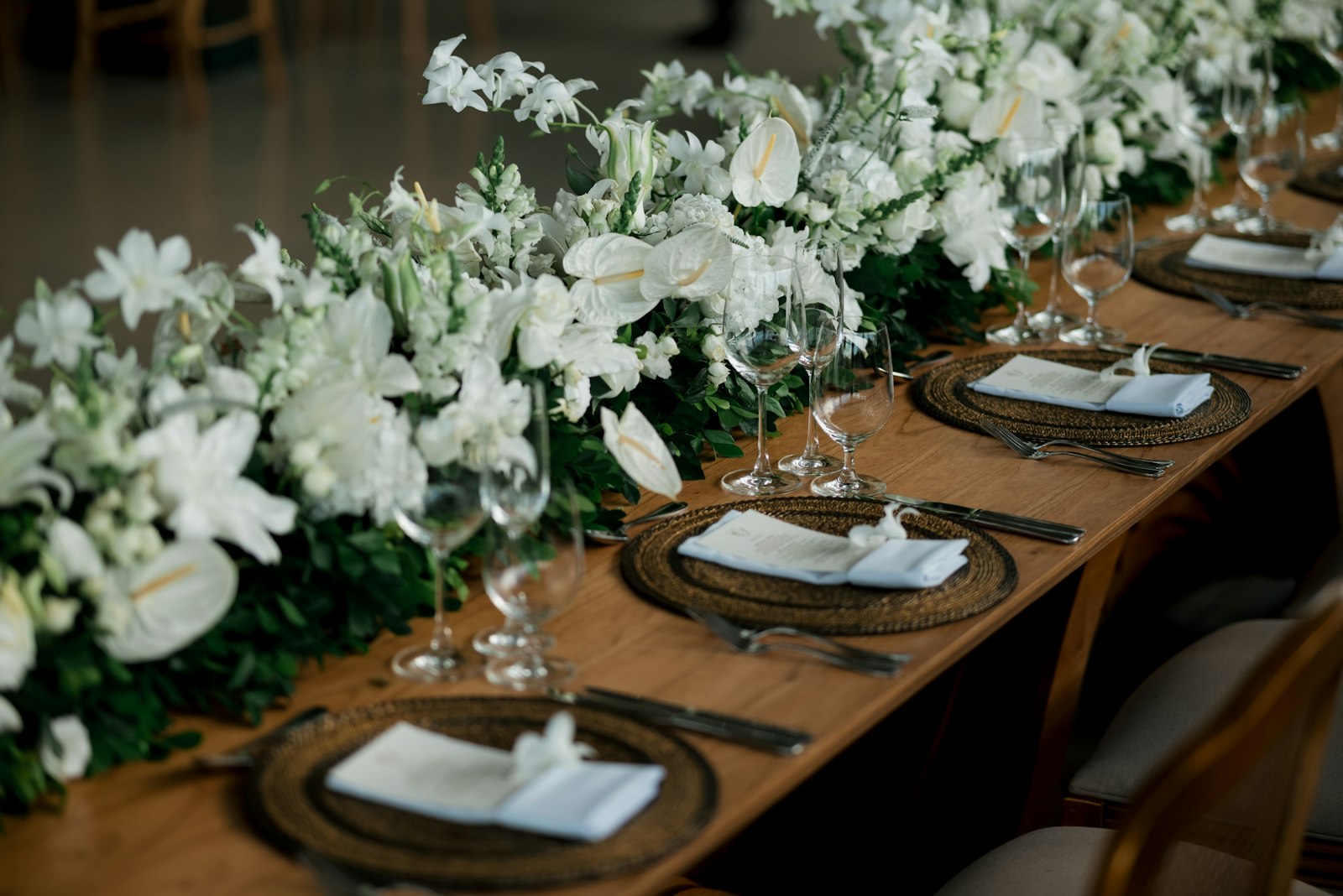
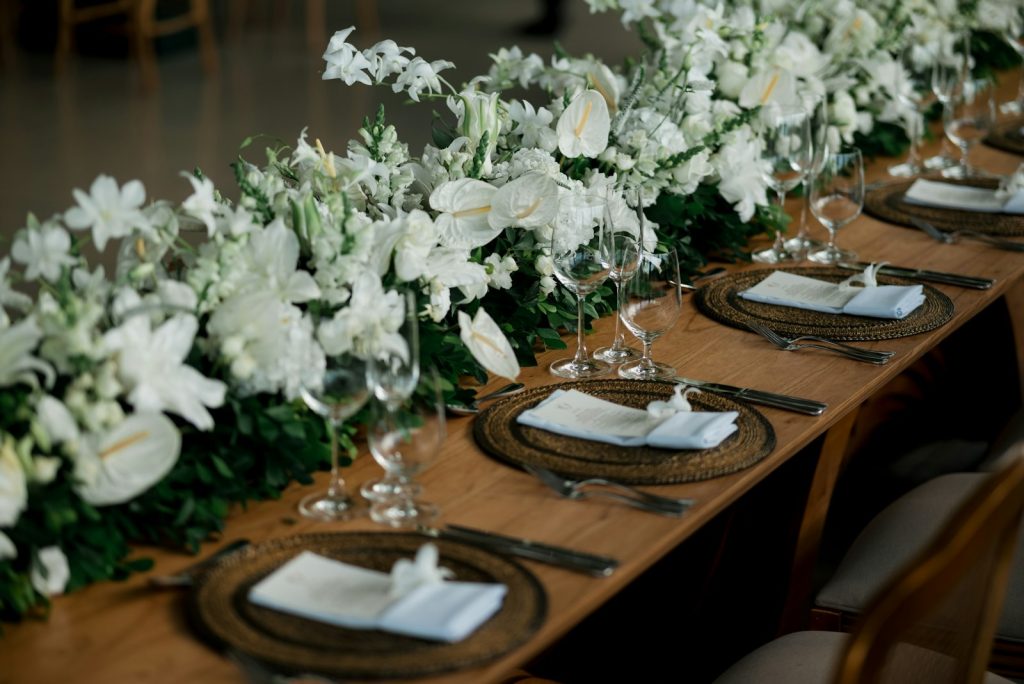
- Tropical species selection matters. Stiff-stemmed blooms — protea, heliconia, anthurium, birds-of-paradise — hold shape under wind far better than thin-stemmed roses or orchid sprays. Discuss this explicitly with your floral designer; they should know the conditions for the sites they work.
- Paper and card stationery. Do not set program cards or loose menus on a table without a weight or a holder. The moment the wind shifts direction, they are gone.
Timing the Ceremony
Trade winds on the south coast of Sumba typically build through the morning and reach their peak in the afternoon. A ceremony timed to begin at 9 or 10 am will generally catch calmer conditions than one scheduled for 3 pm. This cuts against the popular golden-hour aesthetic, but it is a meaningful practical tool, particularly for cliff-top settings.
That said, a morning ceremony on a beautifully lit grass terrace above the Indian Ocean is not a compromise. Many couples who have done it report it as the better choice. The light on the south-west coast is clean and warm in the early hours, the sea is often glassier, and finishing the ceremony before wind peaks leaves the afternoon free for photography at sunset from a more sheltered position.
There is more detail on ceremony timing, light, and the specific window trade-offs in the beach ceremony guide.
Site Orientation and Shelter
If your venue gives you a choice of ceremony positions, ask specifically about wind exposure by direction. West- and north-facing sites are meaningfully better in the dry-season trade-wind months. A site that looks exposed on a map may be sheltered in practice by a ridge, a tree line, or a building mass — and a site that looks sheltered may funnel wind directly through a gap. The property coordinator or planner who knows the site in July should be able to tell you which positions hold up and which do not.
Rain Backup Plan for Sumba Weddings: The Covered Contingency
A rain backup plan for a Sumba wedding means one thing: an identified, confirmed, decorated space that can receive the full ceremony and reception if the outdoor setting becomes untenable. On Sumba, that option is more limited than it is in Bali, and the planning has to be more explicit.
What Resort Properties Typically Offer
Established resort venues generally have some form of indoor or covered space — an open-sided pavilion, a restaurant building with windows open to the view, a covered terrace. The important questions to ask when contracting:
- What is the covered capacity?
- Not every indoor space at a resort can accommodate the same guest count as the lawn ceremony site. If your ceremony site holds 60, confirm that the rain backup holds 60.
- Is the backup space pre-agreed in the contract?
- Some properties charge separately for a backup space or do not guarantee it without a written clause. Get it in writing.
- How quickly can the switch happen?
- A 20-minute rain decision and a 30-minute set-change is a reasonable expectation; confirm the staff protocol in advance so no one is improvising on the day.
- Does the backup space need its own decor plan?
- Often yes. A covered pavilion without any styling looks like a covered pavilion. A modest decor kit adapted for the indoor space — some florals, candles in protected holders, fabric-free installations — should be in your planner’s contingency brief from the start.
Bringing in a Marquee or Temporary Structure
For venues that have no adequate covered backup, a marquee is the alternative. On Sumba, this is not as simple as it is in, say, a Bali villa estate. Marquee suppliers are thin on the island. Equipment may need to travel from Denpasar, and the logistics — trucking, erection crew, tie-down gear — add cost and lead time that is non-trivial in a remote location [confirm availability and lead times with your planner and supplier early in the planning process]. Budget for this as a separate confirmed line item and get a quote rather than treating it as a last-minute call.
A marquee in a south-coast location also needs to be rated for wind, not just rain. A canvas structure pegged inadequately into sandy ground in a trade-wind location is a different risk entirely from a properly anchored, steel-framed event tent. Specify the engineering requirement to the supplier.
The Broader Contingencies That Come With Remoteness
Weather is not the only variable that needs a backup plan on a remote island. The same distance that makes Sumba extraordinary makes it unforgiving to any single point of failure in the logistics chain.
Vendor Flight Delays
The standard professional practice for Sumba weddings is to fly most specialist vendors in from Bali — photographers, videographers, hair and makeup artists, florists, AV technicians, and often the planner’s on-the-ground crew. There are two commercial airports serving the island: Tambolaka (TMC), which serves the south-west, and Waingapu (WGP), which serves the east. Flights operate on turboprop aircraft, typically ATR models, with a block time of roughly 75 to 90 minutes from Denpasar.
Regional turboprop routes are subject to weather-related delays, mechanical holds, and schedule consolidations at a higher rate than mainline jet services. A vendor who cuts it close — arriving the morning of a wedding — is a vendor who, on a delayed flight, misses the ceremony. The industry buffer is one to two days of early arrival for key vendors. Build that into your timeline and into your vendor contracts. It is a real cost, covering additional room nights and per diems, but it is one of the clearest risk-mitigation moves available in this logistics context.
Our detailed breakdown of what to expect when flying vendors in — costs, contract structure, the contingency protocols that experienced Sumba planners use — is in the vendor fly-in guide. If you have specific questions now, reach us on our enquiry form or WhatsApp and we can talk through the specifics.
Road Transfer Margins
Sumba’s road infrastructure outside the main towns is rough. Transfer times between Tambolaka airport and west-coast venues run 40 minutes to over an hour on smooth days; longer after rain, when some road sections become problematic. A guest running late from the airport for a 4 pm ceremony needs the schedule to have real slack. Building a 45-minute margin into every guest arrival assumption is not pessimistic — it is simply accurate to the conditions on the ground.
Power and AV Reliability
Rural power supply on Sumba is less stable than in Bali or the main Java cities. Outages are not daily events at established resort properties, which run backup generators, but in areas away from resort infrastructure, rural power cuts are possible. Any AV setup — sound system, lighting rig, charging points — should have a documented generator backup and a tested handover protocol. Ask the venue specifically: what is the generator capacity, how long can it sustain the ceremony and reception load, and what is the switch-over time? Do not assume. Confirm in writing before the wedding date.
Travel Insurance and Medical Evacuation
Sumba has basic medical facilities. Serious medical situations — acute cardiac events, significant trauma, anything requiring surgery or intensive care — require evacuation to Bali or Jakarta. Evacuation is by air and carries a real cost. This is practical information, not medical or insurance advice: every couple and every guest traveling to a remote island like Sumba should verify that their travel insurance covers medical evacuation before they arrive, and consult a licensed insurance broker if they need guidance on what adequate coverage looks like for eastern Indonesia. The local healthcare reality is simply part of knowing the destination you are choosing.
A Quick Reference: Sumba Wedding Weather Contingency Checklist
| Risk | When it applies | Primary mitigation | Backup |
|---|---|---|---|
| Trade wind gusts at ceremony | June–August, afternoons, south/south-west coast | Morning start; sheltered or N/W-facing site; weighted low-profile decor; no loose drapery | Identified sheltered or leeward indoor position confirmed in advance |
| Unexpected rain in dry season | Any month (low probability Jun–Aug; higher May, Sep) | Choose Jun–Aug dates; monitor forecasts in final week | Confirmed covered space at venue with own decor plan; switch protocol agreed |
| Wet-season rain | Nov–March; peak Dec–Feb | Avoid these months for outdoor ceremonies | Marquee sourced early (confirm local availability); or fully indoor venue |
| Rough south-coast seas | July–September | Choose land-access-only venues; no boat-transfer dependencies | Confirmed road transfer backup for any sea-access route |
| Vendor flight delay | Year-round; elevated for regional turboprop routes | Key vendors arrive 1–2 days early [industry practice; verify with your planner] | Contract clause specifying rescheduling responsibility; backup contact for local support |
| Road transfer delay | Post-rain; year-round on rougher sections | 45-minute schedule margin on all airport and inter-venue transfers | Alternative route identified with driver in advance |
| Power outage or AV failure | Rural locations especially; any time | Venue generator with confirmed capacity and run time; written protocol | Battery-powered audio backup for ceremony; acoustic fallback plan |
Margin as the Core Planning Philosophy
There is a phrase that comes up in every serious conversation about planning a Sumba wedding: build margin everywhere. The island does not offer the infrastructure redundancy of a developed event destination. There is no spare marquee company down the road, no florist who can redeliver on 90 minutes’ notice, no second airport if one closes. What you build into the plan before you arrive is all you have on the day.
That is not an argument against Sumba. It is the honest cost of what Sumba gives you in return — a ceremony setting that no larger, more accessible island can replicate, with a privacy and intensity that couples who have done it describe as unlike anything else in eastern Indonesia. The planning rigor is part of the deal. Couples who thrive in this context are those who involve an experienced planner from the first stages rather than the last, who build genuine flexibility into both the schedule and the contingency arrangements, and who choose a date and a site with a clear-eyed view of the conditions they will be working with.
If you are working through the specifics of your date, your site choice, and your backup plan, our enquiry form is the fastest way to reach us. Or message us directly on WhatsApp at +62 811-3941-4563. We help couples think through exactly this kind of planning scenario — the wind exposure at a specific cliff site in July, the covered capacity of a particular pavilion, whether a September date needs a marquee — without a booking agenda. If you proceed with a partner or operator via our introduction, they may pay us a referral fee at no extra cost to you; no one can pay to change what we publish.
Frequently Asked Questions
Is July really windy enough to affect an outdoor ceremony in Sumba?
It depends on the site and the time of day. July is one of the driest and most reliable months for sunshine, which is why it is among the most popular wedding months. But July sits in the peak of the Australian south-east trade wind, and on exposed south and south-west coast settings, afternoon gusts are consistent and strong. A morning ceremony at a sheltered or north-facing site, with wind-proof decor design, handles the conditions well. An unprotected mid-afternoon ceremony on an open cliff edge with tall floral towers and loose drapery will not.
What counts as a real rain backup plan for a Sumba wedding?
A real backup plan is a confirmed, contracted, decorated alternative space — not an intention to improvise if it rains. For most resort venues, that means a covered pavilion or indoor area whose capacity matches your guest count, pre-agreed in the contract, with a brief decor plan for the indoor configuration. For venues with no covered option, it means a marquee sourced and booked months in advance — not weeks. Sumba does not have the supplier depth of Bali, and a marquee that needs to travel from Denpasar needs a planning lead time that reflects the logistics.
How do I design a wind proof ceremony at a Sumba cliff venue?
Design for the site rather than importing a style that works in a sheltered garden. Low, dense, weighted floral arrangements in heavy containers. Stiff-stemmed tropical species — protea, heliconia, anthurium — over thin-stemmed European blooms. Structural ceremony installations anchored into the ground. No loose fabric panels or hanging textiles in the open. Time the ceremony in the morning before the afternoon wind builds. The clifftop view, the light, the drama — all still there. The wind-proof approach simply keeps them from becoming the chaos.
Do guests need travel insurance with medical evacuation cover for Sumba?
This is a personal decision and we cannot give insurance advice. What we can state as factual context: Sumba has basic medical facilities, and cases requiring surgery or intensive care need air evacuation to Bali or Jakarta — a real cost. Many travel insurance policies cover this; coverage limits and exclusions vary significantly between providers. Every guest traveling to a remote island should verify their own coverage before departure and consult a licensed broker if they are unsure what to look for in the policy terms.
How early should vendors arrive before a Sumba wedding to avoid flight-delay issues?
The professional standard among planners who work Sumba regularly is one to two days of arrival buffer for key vendors — photographer, videographer, hair and makeup, and the floral and decor crew. Regional turboprop routes from Bali to Tambolaka or Waingapu carry a higher delay risk than mainline jet routes. A vendor arriving on the morning of the wedding has no buffer if that flight is held. The buffer adds cost — room nights, per diems — but it is the most concrete single risk-reduction measure available in this logistics context, and experienced planners treat it as standard, not optional.