How to read this: Sumba Destination Wedding is an independent wedding-curation guide — we research and compare cliffside, beach, resort and intimate settings on Sumba, then route your enquiry to a vetted planning partner. We are not a wedding planner, venue, resort or booking platform, and any property named (including well-known names) is a neutral example only, not a claim of endorsement or affiliation. Legal marriage requirements for foreigners in Indonesia are complex — this is general information, not legal advice; always verify current rules with the relevant authorities. Costs are by quote and vary by season, party size and logistics; figures here are indicative ranges only.
The best sumba wedding photo locations fall into five distinct landscape categories: Indian Ocean cliffs and wild-coast beaches, open savannah plains, turquoise coastal lagoons, interior waterfalls, and living megalithic villages. Each category produces a fundamentally different set of images, carries its own seasonal window, and in the case of traditional villages, comes with non-negotiable cultural protocols. This guide covers them all in honest field-guide terms — travel times, access conditions, what the light actually does at each spot, and where respect for community and place must come before the photograph.
How to Use This Guide
Sumba is not a small island. At roughly 10,900 km² across four regencies — West Sumba, Southwest Sumba, Central Sumba, and East Sumba — the distances between landscape types are real. The Tambolaka airport in the southwest (your most likely arrival point if you are flying the DPS–TMC Wings Air route, roughly 85 minutes from Bali) places you within reach of lagoons, coastal villages, and western waterfalls in under two hours. East Sumba’s savannah and mangrove beach are another matter: the road distance from Tambolaka to Waingapu is approximately 250–300 km and takes somewhere between six and eight hours depending on road conditions. That drive is worth planning honestly. You cannot do the eastern savannah and the western lagoon in one shooting day unless you have chartered a small aircraft or have built a multi-day itinerary specifically around photography.
East Sumba also has its own airport — Umbu Mehang Kunda in Waingapu — so couples whose priority is savannah and Walakiri mangrove images can fly directly to the east, stay there for two or three nights, and cover both the waterfall hinterland and the coast without the punishing road trip from the west.
Whatever your itinerary, bring a dedicated photography guide who knows the island. Road navigation on Sumba is not Google Maps reliable. And if your shooting plan involves any traditional village — Ratenggaro, Wainyapu, Praijing, Tarung, or any other kampung adat — the guide’s local relationships are not optional. They are the access.
The Indian Ocean Coast and Limestone Cliffs
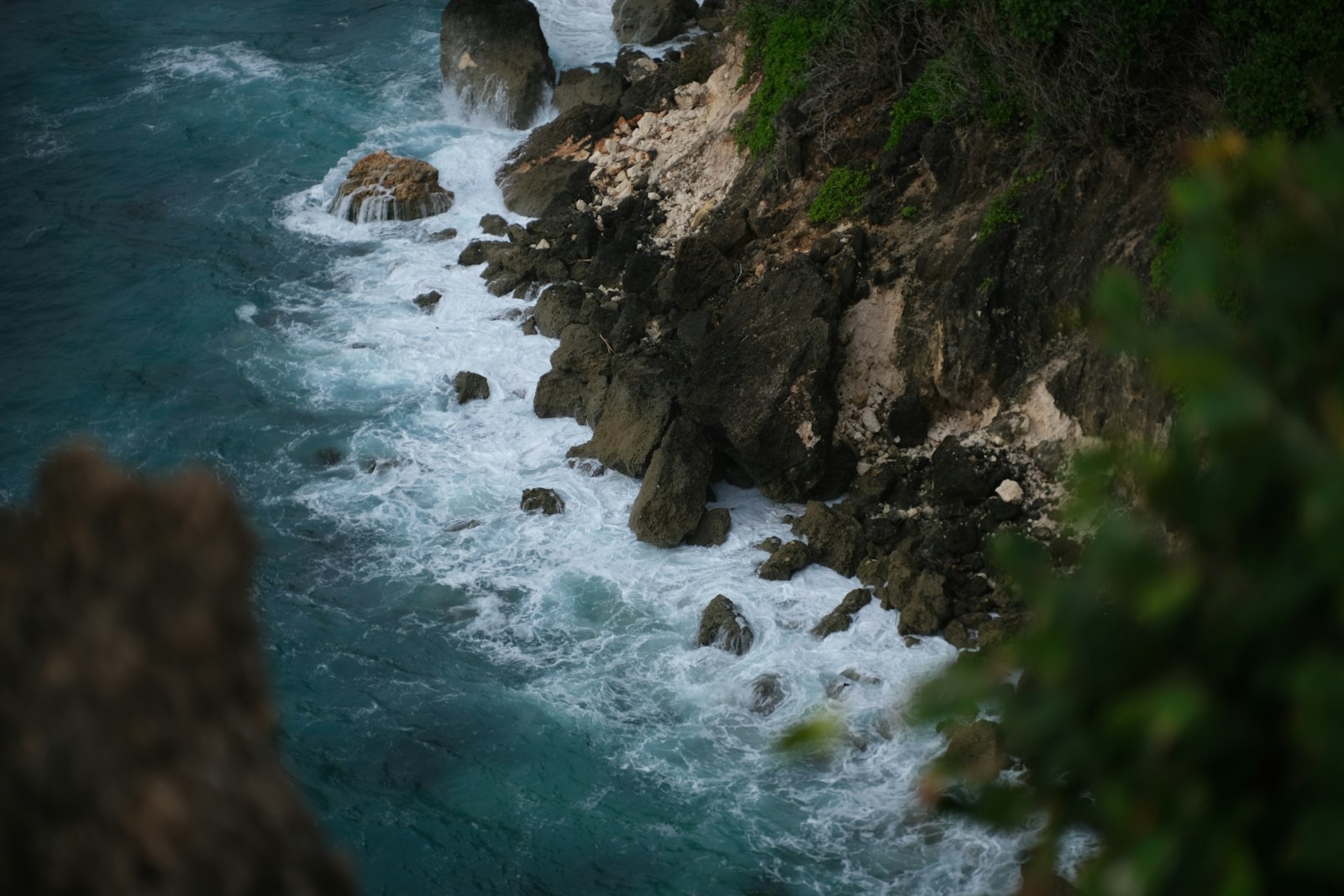
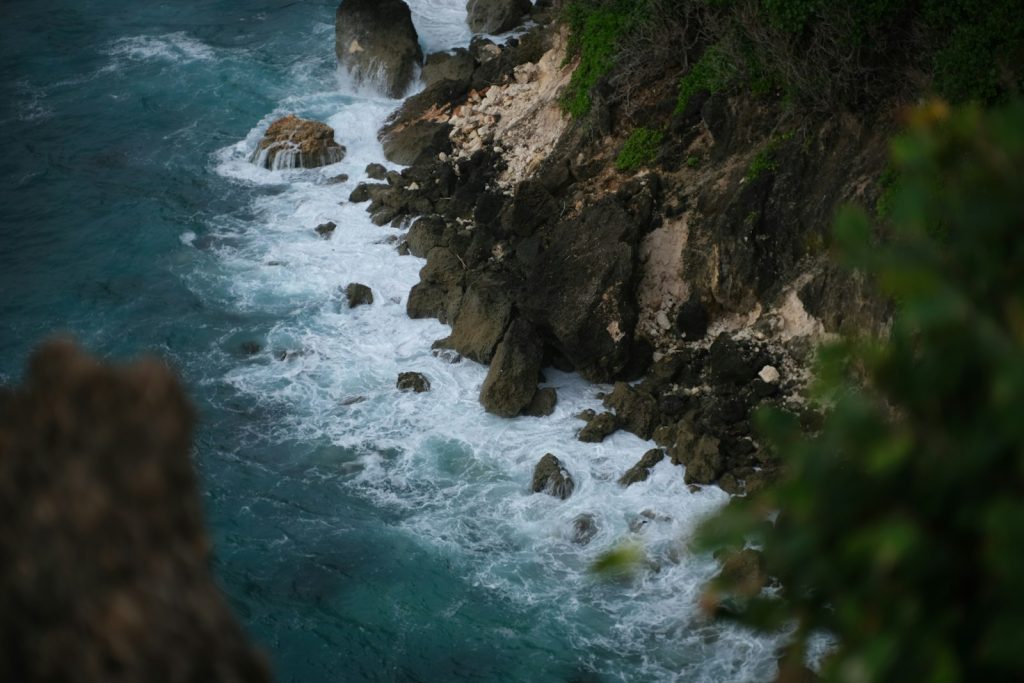
Sumba’s southern coastline is built on limestone, which means the cliffs drop cleanly into deep blue-green water rather than into the shallow gradient you find on volcanic coasts. This produces a sharp, high-contrast backdrop that works very differently from Bali’s terraced-rice panoramas. The light here is intense. Midday on a cliff on the south coast can wash detail out of cream or white garments, so most photographers who know the terrain shoot golden-hour sessions — roughly the ninety minutes before sunset — when the limestone catches warm colour and the ocean darkens behind it.
The exposed south coast carries a practical caveat during the dry season: June through August brings the Australian southeast monsoon, and south-facing headlands can be genuinely windy. Long veils, flowing reception dresses, and delicate floral arrangements need anchoring or a change of plan. The same wind that photographs dramatically can destroy two hours of styling. Have a contingency.
For couples staying in the southwest near Nihi Sumba (the island’s only fully verified five-star destination-wedding property), the private beach and coastal access are part of the resort’s 2.5-kilometre stretch at Hoba Wawi. Images of horses on the beach that appear in Nihi’s own materials and in wedding portfolios associated with the property reflect cultural performance elements that the resort organises — they are not random Sumbanese horses wandering a public shore. If you are not a Nihi guest, do not plan to recreate that imagery on that beach. Access to Nihi’s beach requires being a guest of the property; nothing about it is public or reproducible on demand.
Savannah: Puru Kambera and East Sumba Plains
The savannah landscape that defines Sumba in most internationally published wedding editorial — wide open grassland, horses at a distance, sky taking up two-thirds of the frame — is concentrated in the eastern regency. Puru Kambera (also written Purukambera) is a savannah plateau near Waingapu that is the most frequently cited location for this type of image.
The seasonal distinction here is sharp and couples need to make a genuine choice:
- June to October (dry season)
- Grass is golden to pale brown. The classic straw-coloured Sumba savannah. Best for couples who want that sun-bleached, dramatic open-plain look. Peak is July to September. Daytime heat can reach 33–36°C, sometimes higher in October before the rains arrive.
- January to early June (wet season transitioning to dry)
- January to March brings rains and lush green grass — vivid, almost tropical, with a very different mood from the golden images. Late April to early June is a transitional window: less rain risk than deep wet season, grasses greening but not yet gone gold. Some couples specifically book this window for green-savannah portraits. The trade-off is cloud cover and occasional afternoon showers — manageable but not as reliably clear as July.
There is no single answer. The golden look and the green look are both real, both achievable, and they suit different couples’ aesthetic. What is not acceptable is promising yourself the dry golden savannah and arriving in February. Be deliberate about this, because Sumba wedding months (late June through late August for best weather overall) and Sumba savannah peak season align well — that is fortunate.
Horses appear in this landscape according to local reports, though their presence at any given spot on any given morning is not guaranteed. East Sumba has a tradition of horse-keeping tied to culture and transport, and they graze on open savannah. A local guide can improve the odds of finding horses in frame, but a photographer who promises you horses at a specific time and place without a local arrangement is overselling the guarantee.
Weekuri Lagoon and Mandorak
Weekuri Lagoon sits on the southwest coast near Kodi, roughly an hour and a half to two hours from Tambolaka by road depending on which section of track is in use. It is a brackish tidal lagoon separated from the Indian Ocean by a limestone karst barrier, and the water colour — pale turquoise to clear blue-green — photographs in a register that is hard to achieve anywhere else on the island. Couples who want water portraits without a full beach setup often choose Weekuri for its shallow, calm, wading depth.
Mandorak Beach is a nearby stretch of the same limestone coast with a different character — more exposed, with dramatic rocky outcroppings framing the water. It is less visited than Weekuri and the access road is rough. Both spots in this coastal cluster are best reached in the morning before afternoon haze builds. Neither requires formal permits as of widely reported practice, but this can change with local arrangements, so confirm with your guide before building a firm schedule around it.
For couples whose primary photoshoot aesthetic is watercolour-palette beach portraits — teal water, pale limestone, neutral sand — this southwest cluster is the strongest location on the island.
Waterfalls: West and East
Sumba has a number of interior waterfalls accessible to wedding and portrait photographers. The most commonly referenced fall in two geographic clusters:
Lapopu Waterfall (West Sumba)
Lapopu is located in West Sumba’s interior, not far from Waikabubak. It is the most accessible of the major waterfalls from the western resort area and is genuinely impressive in scale — wide curtain falls into a pool, surrounded by forest. The wet season brings the highest volume and the most dramatic flow; the dry season is more accessible (roads are better) but the falls run thinner. For couples based in the southwest, Lapopu is the realistic waterfall option without crossing to the east. The trek to the pool involves a walk on forest trail, so footwear and styling choices need to account for that.
Waimarang and Tanggedu (East Sumba)
Waimarang and Tanggedu are east Sumba waterfalls with a more remote, expedition quality. Tanggedu in particular has appeared in travel photography as a multi-tiered fall through limestone canyon terrain — visually distinctive from the west-Sumba forest falls. Both require more travel time from Waingapu than Lapopu requires from the western airport, and road conditions can make that time highly variable. Early-season dry (May–June) tends to offer better flow than late dry (September–October) while still being passable. These falls reward couples willing to build a dedicated half-day into their itinerary for the purpose.
For any waterfall shoot: bring a waterproof bag for camera gear, expect the light to be filtered through forest canopy (gorgeous for portraits, challenging for auto-exposure), and plan footwear that can handle mud and wet rock.
Walakiri Mangrove Beach (East Sumba)
Walakiri is on the north coast of East Sumba, a short drive from Waingapu. The beach is known for its mangrove trees that stand in the tidal shallows, creating a silhouette landscape at sunset that is among the most photogenic in eastern Indonesia. The shot most associated with the place — a couple standing in ankle-deep water with mangrove trunks silhouetted against a gold-orange sky — requires being there within about thirty minutes of local sunset and having a flat-sea, clear-horizon evening.
This is one of the best sumba portrait spots for couples who want graphic, high-contrast sunset imagery rather than the lush botanical look. It reads as editorial rather than romantic pastoral. The mangroves are living trees in a tidal ecosystem; do not climb them, do not damage branches for a frame, and do not leave equipment or rubbish in the tidal zone.
Walakiri is accessible without specialist permits as widely reported, but it sits within a working coastal community — go with a guide, be courteous with locals who are using the shore, and do not assume the beach is an exclusive studio.
Megalithic Villages: Ratenggaro, Wainyapu, Praijing, Tarung
This is where the photography brief and the cultural responsibility brief overlap most directly, and where I will be plainest about what the editorial line here is: megalithic villages in Sumba are living communities, not open-air museums. The stone tombs — massive carved slab constructions that occupy the central space of the kampung — are not props. They hold the remains of ancestors and remain active in Marapu ceremonial practice according to local tradition. Getting good photographs here requires earning access with genuine respect, not scheduling a shoot and arriving with a light stand.
Ratenggaro and Wainyapu (SW Coast)
Both sit on or near the southwest coast and are accessible from Tambolaka within one to two hours. Ratenggaro is sometimes described as one of the most visually striking traditional villages on the island: peaked thatched uma houses rise behind a row of coastal megalithic tombs, with the Indian Ocean as backdrop. The combination of ancient architecture, stone tombs, and coast in one frame is architecturally rare anywhere in the world.
Wainyapu is nearby and is known for its connection to the Pasola ceremony — the sacred mounted spear-throwing ritual tied to the lunar calendar and the nyale sea-worm appearance, occurring in the West and Southwest according to local tradition in the February–March window [verify dates locally, they are set by ritual authorities each year, not fixed in advance]. Do not attempt to use Pasola as a wedding backdrop. It is a fertility and harvest rite with its own participant rules and its own sacred timeline. Spectators are sometimes permitted but the ritual is not a location for a wedding photoshoot.
Praijing / Prai Ijing and Tarung (Near Waikabubak)
Both are inland villages near the West Sumba capital Waikabubak, more accessible from the town than the coastal villages. Praijing sits on a hilltop with panoramic views and traditional architecture that is frequently photographed by travel journalists. Tarung is one of the older established ceremonial villages in the region. Both have been subject to fire damage in recent years with subsequent rebuilding [confirm current access and village state locally before visiting]. The rebuilt structures may differ from what appears in older reference photography — verify with a current local guide.
Cultural Protocol for All Village Visits
These are firm, non-negotiable, and they are not unique to Sumba — they apply to any living traditional community anywhere:
- Ask before photographing people. This means verbally, through a guide who can translate. A camera pointed at someone without permission is a violation, regardless of whether the village charges an entry contribution.
- Do not climb or sit on the tombs. They are ancestral graves and ceremonial objects. This is a basic matter of respect and it is observed as a firm rule according to local custom.
- Drone use requires explicit consent from the village leader (kepala adat or equivalent). Do not fly first and ask forgiveness later. Drones over a sacred village are an intrusion on a scale that a camera on the ground is not.
- Dress modestly. Shoulders and knees covered. The dressed-up wedding couple is fine; the photographer team in beach shorts is not.
- Pay the customary village contribution. Most traditional villages on Sumba receive visitors and have a contribution system in place. This is not a tourist tax — it supports community maintenance. Your guide will know the current amount and how to handle it correctly.
- Never stage mock rituals. No re-enacting Marapu ceremonies, no having a village elder perform a blessing that is not a real blessing. If a ceremony is real and you are invited to witness it, witness it. If it is staged for photography, you are asking a community to commodify its sacred practice for your album. That is not what we recommend here.
Approached properly — with a guide who has genuine community relationships, with advance notice, and with genuine curiosity rather than a shot list — a village visit can be among the most moving parts of a Sumba wedding trip. The photography is secondary to the encounter.
If you are building a multi-location photography itinerary and want honest guidance on which spots are realistic for your dates, travel base, and style, reach out via our enquiry form or on WhatsApp at +62 811 3941 4563. We work with couples on both sides of the island and can flag which combinations are logistically honest versus aspirational.
Practical Location Comparison
| Location | Region | Best Season | Drive from TMC (approx.) | Primary Look | Key Access Note |
|---|---|---|---|---|---|
| Nihi private beach / cliff | SW | Jun–Aug | ~40–60 min | Wild coast, horse beach | Guests only |
| Weekuri Lagoon | SW | Apr–Oct | ~1.5–2 hrs | Turquoise tidal pool | Public, rough road |
| Mandorak Beach | SW | Apr–Oct | ~2 hrs | Limestone coast, dramatic | Rough access track |
| Ratenggaro Village | SW | Year-round | ~1–1.5 hrs | Megalithic coastal village | Community permission required |
| Wainyapu Village | SW | Year-round | ~1–1.5 hrs | Traditional village, Pasola site | Community permission; no Pasola staging |
| Lapopu Waterfall | West | Nov–May (volume); Jun–Oct (access) | ~1 hr from Waikabubak | Forest waterfall, pool | Forest trek required |
| Praijing / Prai Ijing | West | Year-round | ~5 min from Waikabubak | Hilltop village, panorama | Verify post-fire rebuild status |
| Tarung Village | West | Year-round | ~10 min from Waikabubak | Ceremonial village | Verify access locally |
| Puru Kambera savannah | East | Jun–Oct (golden); Jan–May (green) | ~6–8+ hrs from TMC / near WGP | Open savannah, wide sky | Base in Waingapu |
| Walakiri mangrove beach | East | May–Sep (dry, clearer skies) | ~6–8+ hrs from TMC / short from WGP | Mangrove silhouette sunset | Tidal timing critical |
| Tanggedu Waterfall | East | May–Jun (flow + access) | ~6–8+ hrs from TMC / 2+ hrs from WGP | Limestone canyon tiered falls | Remote, rough road |
| Waimarang Waterfall | East | May–Jun | ~6–8+ hrs from TMC | Interior waterfall | Local guide essential |
Drive times from Tambolaka (TMC) to east Sumba are rough estimates based on inferred road distance of ~250–300 km; actual times vary significantly with road conditions. Verify locally before building tight itineraries around these figures.
Planning a Multi-Location Shoot
Most couples working with a skilled Sumba-based or Bali-based photographer who travels to Sumba end up selecting two or three location types rather than trying to cover the whole island. A common western-focus combination is the resort coastal setting for the ceremony day, Weekuri or Mandorak the morning after, and a village visit on the third morning — all reachable from a southwest base without the eastern crossing.
Couples who specifically want the savannah look should plan a dedicated eastern trip, ideally two nights in Waingapu to cover Puru Kambera at golden hour, Walakiri at sunset, and Tanggedu or Waimarang as a half-day excursion. Tacking that onto a western wedding without travel days is optimistic planning.
Photography vendors for Sumba weddings almost universally fly in from Bali — the local pool is thin. A photographer arriving on the same day as your shoot has no margin for a delayed flight. The standard practice among experienced Sumba wedding photographers is to arrive one to two days early. Build that into the budget (their accommodation and transfer) and the schedule.
When you are ready to start mapping a real itinerary — locations, dates, which photographers know the island, and what is actually feasible in your window — send us a note through our enquiry form or reach us directly on WhatsApp at +62 811 3941 4563. No one can pay us to change what we publish; if you use our free help and proceed with a partner or operator, they may pay us a referral fee at no extra cost to you.
Frequently Asked Questions
Can we shoot at any beach in Sumba, or do some require permission?
Most beaches on Sumba are publicly accessible without formal permits. The key exception is Nihi Sumba’s private beach stretch at Hoba Wawi, which is resort-access-only — you must be a guest to shoot there. For village-adjacent beaches and coastal areas near traditional communities, asking local permission before setting up a photoshoot is the right approach regardless of whether there is a formal requirement. A local guide handles this naturally.
Is golden-savannah photography only possible in the dry season?
Yes. The dry-season palette — straw gold to pale brown grassland under a clear sky — is a June through October phenomenon in the east, with the peak looking roughly July to September. Outside that window the savannah is green (lush but a different aesthetic) or partially dried and patchy during the transition months. Couples who book a March wedding and specifically want golden savannah images should know the limitation clearly before finalising dates.
What is the etiquette for photographing inside a traditional village?
Always arrive with a local guide who has a prior relationship with the village or who can formally request access from the kepala adat. Ask permission before photographing individuals — through your guide if there is a language barrier. Do not photograph ceremonial objects, sacred items, or interior domestic spaces without specific invitation. Do not position subjects on or near the ancestral tombs. Pay the customary village contribution. Modest dress for the entire group, not just the couple. These are not optional niceties; they are the conditions under which a village will continue welcoming visitors.
How far in advance should we arrange photography location scouting?
For any wedding in the June–August peak season, confirm your photographer and their travel arrangements at least three to four months in advance. Sumba-experienced photographers are a small pool and they book out. For village visits, your guide should make contact with the community at least a week ahead — ideally more — rather than arriving unannounced. For drone use at any site, village or otherwise, that permission process can take longer and should be initiated well before the shoot date.
Can we combine east and west Sumba photography in a one-week trip?
Yes, but it requires intentional planning. The road crossing between Tambolaka in the southwest and Waingapu in the east is approximately 250–300 km and takes six to eight hours or more — do not schedule a shoot on an arrival or departure day if you are driving. The more comfortable option for couples who want both sides is to fly into Tambolaka (TMC) for the western locations, then take the short regional flight to Waingapu (WGP) for the eastern segment, treating them as two distinct bases. A week with three nights west and three nights east is a realistic structure. A driver-only approach in a single week without flight connections between the airports will consume two full driving days of your trip.