
How to read this: Sumba Destination Wedding is an independent wedding-curation guide — we research and compare cliffside, beach, resort and intimate settings on Sumba, then route your enquiry to a vetted planning partner. We are not a wedding planner, venue, resort or booking platform, and any property named (including well-known names) is a neutral example only, not a claim of endorsement or affiliation. Legal marriage requirements for foreigners in Indonesia are complex — this is general information, not legal advice; always verify current rules with the relevant authorities. Costs are by quote and vary by season, party size and logistics; figures here are indicative ranges only.
A sumba cliffside wedding venue is not a category you’ll find with a standard venue search. It’s a setting — limestone bluffs hanging above the Indian Ocean — that exists within a handful of resort properties and private estates on Sumba’s west and southwest coast. No purpose-built cliff chapel, no dedicated clifftop event company, no roster of standalone outdoor venues. What you get is access to a dramatic natural edge as part of a larger property arrangement, usually a resort buyout or a private estate hire. That distinction matters before you plan anything.
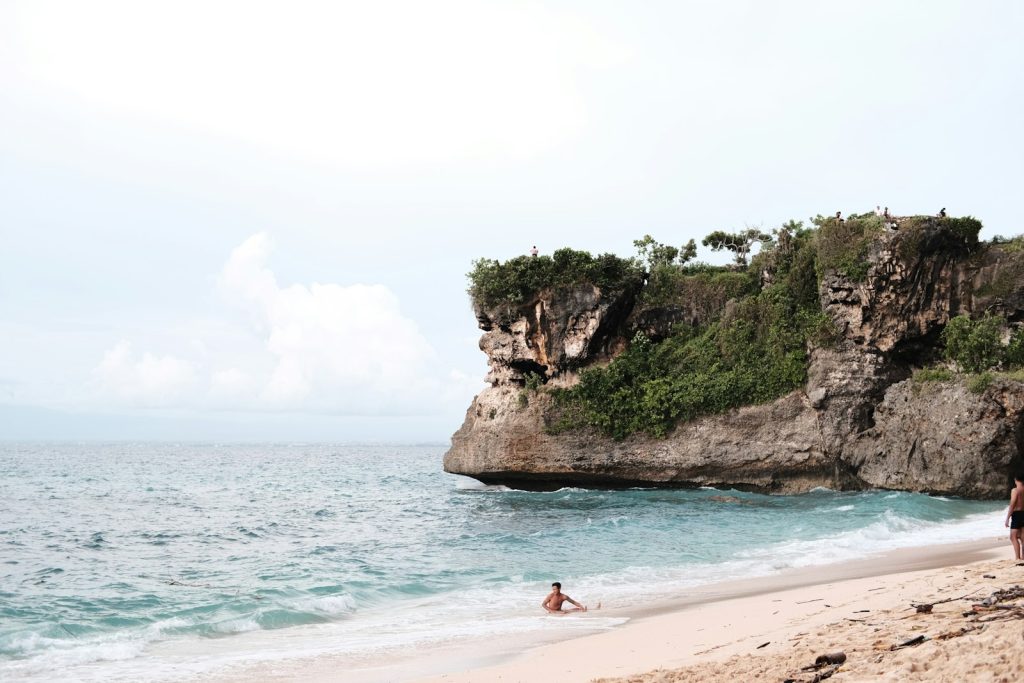
Sumba’s south coast drops into the Indian Ocean on limestone cliffs that have no equivalent in Bali or Lombok. The savannah rolls to the edge, the sky is enormous, and at golden hour the light turns everything amber. For couples who want a ceremony that feels genuinely wild and remote — not styled, not packaged — this is what the island offers. The tradeoff is real: rough access roads, exposed weather, and infrastructure you’ll have to bring in yourself.
What “Cliffside” Actually Means on Sumba
Across Sumba’s wedding-capable properties, a clifftop ceremony setting means one of three things. First, a designated outdoor area at a resort that sits on or near a cliff edge — typically a manicured lawn or terrace where the ceremony arch faces the ocean drop. Second, a raw point on a private estate where you and your planner essentially create the setup from scratch. Third, a stretch of coastal grassland accessible from a resort that offers it as a ceremony location option.
None of these is a dedicated clifftop venue in the way that a Balinese resort might have a purpose-built ocean-view temple or glass-floored pavilion. Sumba’s properties are small, boutique, and understated by design. The cliff is a feature of the landscape, not an architectural product. That rawness is the point for most couples who choose it.
The south and southwest coast — the Nihiwatu and Wanukaka area, and further west toward Waikabubak — concentrates most of the island’s cliffside character. The terrain here is limestone-based, the vegetation drier than Bali, and the cliff drops are genuine: not decorative bluffs but actual headlands above open ocean. If you have seen photographs of Sumba ceremony settings with nothing but ocean horizon and big sky behind the couple, that is almost certainly this coast.
The Verified Properties: What We Know, What to Confirm
Nihi Sumba (formerly Nihiwatu)
Nihi Sumba is the only property on the island with a fully verified, dedicated weddings program. The resort sits on the southwest coast in the Hoba Wawi area near Wanukaka, on approximately 560 acres with 2.5 kilometres of private beach. Their Celebrations program covers everything from elopements to full resort buyouts, and they have published a wedding brochure that outlines ceremony types: a Protestant symbolic ceremony in English, a Catholic ceremony at the island church, or a traditional Sumbanese blessing led by a local Rato (village priest).
Ceremony settings at Nihi include clifftop areas, gardens, and beach locations — the property has enough land that the setting can be tailored to what a couple wants. Capacity is approximately 70 adults across around 36 rooms and villas (Nihi’s own pages use slightly inconsistent numbers between documents — confirm the current room count and configuration directly with the property). For larger guest lists, a full resort buyout is the model; for very intimate celebrations, they accommodate elopements.
Pricing is inquiry-only. A property of this calibre, with a full buyout model and a near-complete suite of in-house services, sits far above standard Bali resort packages. As a rough planning orientation, informed industry estimates for a full resort buyout of this type run well above $50,000 and can reach $200,000 or more depending on duration, guest count, and production scope. These are general planning bands, not sourced Nihi figures — get a quote directly. No one can give you an honest number without knowing your dates, guest list, and what you want to produce.
What Nihi provides in-house: venue and ceremony sites, all food and beverage, service staff, an on-site events coordinator, local cultural elements including the Rato blessing, betel-nut chewing ritual, ceremonial horses, and Sumbanese music and dance. What you will typically bring in: photography and videography, full floral and décor design, bridal hair and makeup, and any advanced AV or entertainment beyond their standard setup.
Lelewatu Resort Sumba
Lelewatu Resort is a real luxury property positioned on a clifftop in west or southwest Sumba near Waikabubak. It is clifftop-sited, honeymoon-focused, and the kind of intimate boutique lodge that photographs beautifully. Whether it has a formal wedding program — ceremony packages, coordinator, dedicated ceremony infrastructure — is something you need to confirm directly with the property. [VERIFY with Lelewatu]
A clifftop wedding at Lelewatu Sumba is plausible. The location is right, the setting is right, and boutique properties at this level often accommodate bespoke requests even without published programs. But plausible is not the same as available, and a bespoke arrangement for a dramatic cliff ceremony on Sumba at a property without a dedicated events team requires earlier groundwork and more planning buffer than a resort with an established program. Contact them, ask specific questions, and get answers in writing before you build a timeline around this location.
Cap Karoso
Cap Karoso is a genuine upscale design and eco resort on Karoso Beach in southwest Sumba, relatively close to Tambolaka airport. It appears in marketplace listings as a wedding-capable venue, and its design sensibility — architectural, considered, with strong landscape integration — makes it credible as a ceremony setting. We have not found a dedicated wedding page or published program. [VERIFY with Cap Karoso]
Wind, Light, and Weather: What Nobody Tells You About a Clifftop Wedding on Sumba
The dry season — roughly June through September — is when Sumba is at its most reliable and most beautiful. Clear skies, no rain, golden savannah. It is also when the Australian southeast monsoon pushes strong consistent winds up the south coast. On an exposed cliffside or clifftop, those winds are not a gentle breeze. They will displace floral arrangements, flip ceremony programs, tangle veils, and make spoken vows difficult to hear without good sound reinforcement.
This is not a reason to avoid a clifftop setting in dry season. It is a reason to plan for it specifically. Wind-proof décor means weighted structures, low arrangements, and lanterns rather than tall florals. Sound means a system that can push audio into the wind, positioned so guests are not straining to hear. Timing matters too: the strongest wind on the south coast often peaks in the afternoon and eases a little in the early morning or at midday. Your vendor team needs to know the site, not just the island.
The afternoon light from roughly 3pm through sunset is genuinely extraordinary on Sumba’s west coast. The low angle, the clear dry-season air, and the ocean backdrop combine in a way that no Bali garden setting can replicate. The payoff for the wind challenge is real. Most couples who have done a cliff ceremony here say the conditions added to the drama rather than detracting from it — but they planned for it.
One practical note on the dry-season south coast: seas from July through September are too rough for swimming and can be visually dramatic in photographs but can also generate significant spray and noise at the cliff base. For couples wanting calm water in the background, the dry season on the west-facing beaches — rather than the exposed south coast — can offer a slightly more sheltered alternative.
Getting There: Access, Roads, and Transfer Times
Sumba’s main western gateway is Tambolaka Airport (IATA: TMC, now formally named Lede Kalumbang Airport), roughly five kilometres from Tambolaka town. Direct flights from Bali’s Ngurah Rai Airport operate on turboprop aircraft — Lion Air Group and at times Garuda Indonesia — with a block time of approximately 75 to 90 minutes. It is about 400 to 450 kilometres from Bali. East Sumba is served by Waingapu Airport (WGP). Most cliffside-area properties are in west or southwest Sumba, so Tambolaka is the relevant airport for the venues discussed here.
From Tambolaka to the main resort corridor on the southwest coast, expect a transfer of roughly 45 minutes to over an hour depending on exact destination and road conditions. Roads in west and southwest Sumba vary: the main arterial roads are paved, but side roads to coastal resorts and private estates can be rough, unpaved in sections, and slower than a map distance suggests. Budget significant transfer time and factor in that arriving guests — especially elderly family members — will need comfortable vehicles and a realistic schedule.
If your guest list includes older or mobility-limited guests, a clifftop ceremony site adds one more variable: uneven ground, grass or gravel surfaces, and sometimes a walk from a vehicle drop-off point to the ceremony location itself. Discuss the specific terrain with your venue and planner. Some sites have reasonable access; others require a short walk over irregular ground. This is not disqualifying — it just needs to be communicated clearly to guests well in advance so no one arrives in city shoes expecting a paved terrace.
Infrastructure: What Gets Trucked In, What Gets Flown In
On a remote island with limited local supply chains, a clifftop ceremony setting essentially starts as a blank space. Chairs, sound equipment, shade structures, florals, lighting, and the ceremony arch all have to arrive at your site. Some of that comes from the resort’s inventory if you are working within a property’s program; the rest — particularly the décor design, premium florals, and professional AV — typically comes from Bali.
Florists, photographers, videographers, hair and makeup artists, and sound technicians for Sumba weddings usually fly in from Bali, typically arriving one or two days before the event to allow for flight delays and acclimatization. Their airfare, accommodation, meals, and a day rate for travel time all add to your total cost. Freight for décor and equipment that cannot be hand-carried goes by cargo flight or sea freight — the logistics add both time and expense. This is not an obstacle; it is a known part of Sumba wedding production. Budget for it explicitly.
Shade is a serious practical consideration on an exposed clifftop in dry season. Daytime temperatures hit 30 to 33°C, and on a cliff without tree cover, the sun is direct. A late afternoon ceremony timing solves much of this — by 3:30 or 4pm the light is better and the heat is easing — but if your ceremony runs longer or starts earlier, shade structures for guests matter. Tensile shade sails or a styled tent can work on clifftop sites; discuss structural anchoring with your planner given the wind conditions described above.
Sound reinforcement on an open cliff requires wireless lavalier microphones for the officiant and key speakers, and a PA system positioned to project toward the guest seating rather than into the wind. A competent AV team who has worked on exposed coastal sites is worth briefing specifically on these conditions.
Planning a clifftop ceremony on Sumba and want to confirm which venues are currently accepting bookings? Use our enquiry form or message our concierge on WhatsApp (6281139414563) — we connect couples with vetted local partners who can verify current cliff-site availability and walk you through what each setting actually involves. No obligation, no sales pitch.
Honest Capacity: Who This Is Right For
Sumba’s clifftop wedding settings are intimate by nature. Nihi Sumba’s verified capacity is approximately 70 adults on a full resort buyout. Lelewatu and Cap Karoso, as boutique properties, will be smaller. Private estate arrangements depend entirely on what the land can accommodate and what infrastructure you bring in.
If your guest list is 20 to 60 people, Sumba — and a clifftop setting within that — works beautifully. If you are planning 100, 150, or more guests, Sumba is the wrong island. The accommodation stock is not there, the logistics compound with guest count, and no single property can comfortably host a large group. This is not a shortcoming to apologize for. It is a character trait. Sumba’s cliffside settings reward the couple who chooses intimacy over spectacle, who wants the ceremony to feel genuinely wild, and who is comfortable with the planning discipline that a remote island demands.
Cost Reality for a Clifftop Ceremony on Sumba
Expect to pay more on Sumba than on Bali for a comparable production level. The premium is driven by remote logistics: vendor flights, excess baggage, accommodation for out-of-town crew, limited local vendor competition, and contingency buffers for weather and transport. A mid-range Bali resort wedding and a mid-range Sumba wedding at the same guest count and décor level are not the same price.
As rough orientation only — these are not sourced Sumba-specific figures and your actual cost will depend entirely on your choices:
| Format | Guest range | Indicative range | Notes |
|---|---|---|---|
| Intimate / elopement | 2–15 | $15,000–$40,000+ | Depends on photography, floral, and property fee; vendor fly-in adds fixed cost even for small groups |
| Small gathering | 20–40 | $40,000–$100,000+ | Venue hire or partial buyout, catering, flown-in vendors, logistics buffer |
| Full resort buyout | 50–70 | $80,000–$200,000+ | Luxury tier; Nihi-style buyout at the high end; quote-only, no fixed pricing published |
Per-head catering at a luxury level runs roughly $80–150+ per guest. Planner fees typically fall in the 10–15 percent range of the total event budget — and on a remote island the coordination complexity justifies every cent of that. Do not attempt a Sumba clifftop wedding without a planner who has either worked on Sumba specifically or has produced events on comparably remote Indonesian islands.
Sumbanese Cultural Context at a Cliffside Ceremony
Sumba is not a secular backdrop. The land carries deep significance under Marapu, the indigenous ancestral belief system that continues to be practiced on the island alongside Christianity. Clifftop and coastal sites may be near or adjacent to traditional village land. This is not an obstacle to a ceremony; it is context that deserves respect.
If you incorporate a Sumbanese cultural element — a Rato blessing, traditional Sumbanese textiles as décor, local music — engage with it sincerely and through the proper intermediaries. Nihi Sumba has established relationships with local village leaders and the Rato who conducts blessings; if you are working with another property or a private estate, ask your planner who the appropriate local contact is. Do not treat Marapu-adjacent elements as aesthetic props. A genuine blessing from a respected Rato, performed correctly, is one of the most moving ceremony elements a couple can experience on Sumba. A performative imitation of it is the wrong way to approach this.
Similarly, Sumba’s handwoven ikat textiles — the tenun ikat for which the island is nationally recognized — are deeply meaningful objects used in ritual exchanges, including traditional marriages. Incorporating them into your decoration or ceremony styling is welcome; cutting heirloom cloths or using sacred pieces as table runners is not.
Health and Practical Logistics for Guests
Sumba sits in an area of eastern Indonesia with ongoing malaria transmission risk — unlike Bali, which carries low to no risk for most travelers. This is important information to share with every guest well in advance so they can consult a travel-medicine doctor about appropriate prophylaxis. This is information, not medical advice; decisions about medication belong with each guest and their doctor.
ATMs on Sumba are limited and can be offline; bring sufficient IDR in cash, and advise guests to withdraw in Bali before the connecting flight. Mobile data coverage is patchy outside towns. Power outages in rural areas are not rare — if your ceremony or reception involves significant electrical equipment, a generator backup is not optional. The island runs on 220V 50Hz with European C/F two-round-pin plugs; guests arriving from the US, UK, or Australia need adapters.
Medical facilities on Sumba are basic. For any genuine emergency, evacuation to Bali or Jakarta is required. Travel insurance with medical evacuation cover is not optional for a Sumba wedding; it is a condition of participating responsibly in an event on a remote island.
Build your guest schedule with generous margins on travel days. The Tambolaka to southwest-coast resort transfer can run an hour or more on roads that are not always smooth. A guest who lands tired and then endures a long rough road transfer arrives at a cliff ceremony in a different state than one who had a transit day built in.
Ready to start the conversation? Submit an enquiry or reach us on WhatsApp at 6281139414563. We’ll connect you with a vetted partner who knows which cliff sites are active, current availability, and what an honest budget looks like for your guest count. No one can pay us to change what we write; if you proceed with a partner through our introduction, they may pay us a referral fee at no extra cost to you.
Frequently Asked Questions
Is there a dedicated clifftop wedding venue on Sumba I can book independently?
Not in the way you might book a standalone chapel or pavilion. Clifftop ceremony settings on Sumba exist within resort properties — most notably Nihi Sumba, and potentially Lelewatu Resort and Cap Karoso pending verification with each property. There is no purpose-built, independently operated cliffside wedding venue. A clifftop ceremony is something you arrange as part of a resort hire or private estate agreement, typically with a planner coordinating the site access and setup.
How bad is the wind at a clifftop ceremony in June, July, or August?
Strong enough to plan around. The Australian southeast monsoon produces reliable dry-season winds that can be persistent on Sumba’s exposed south coast from June through August. This is the same period that gives you clear skies and the golden savannah. Wind-proof décor — weighted structures, low florals, enclosed candles — and a properly positioned PA system are standard planning measures. The late afternoon timing (from around 3:30 to 4pm onward) can give slightly calmer conditions and also delivers the best light. Your on-island planner should know the specific wind pattern at your chosen site.
What is the Lelewatu Resort Sumba wedding program actually like?
Lelewatu Resort Sumba is a real luxury clifftop property in west Sumba, honeymoon-positioned and architecturally compelling. Whether it currently offers a formal wedding program with a coordinator, published ceremony packages, and dedicated ceremony infrastructure is something that needs to be confirmed directly with the property — we flag this as unverified. If you are drawn to Lelewatu for a clifftop ceremony, contact them directly and ask specific questions about what they can provide, what they require you to bring in, and what lead time they need. A bespoke arrangement may be entirely possible; you need their answers in writing to plan reliably around it.
Can older or mobility-limited guests attend a cliffside ceremony on Sumba?
It depends on the specific site and how you set it up. Sumba’s clifftop areas are not landscaped to accessibility standards; ground surfaces are often grass, gravel, or natural terrain. The transfer from the airport involves a long road journey on roads that are not always smooth. That said, a well-planned event with the right vehicles, a ground-level ceremony setup, sturdy seating, and staff assistance can accommodate guests with limited mobility. Discuss the exact terrain of your chosen ceremony site with your venue and planner before finalizing, and be honest with guests about what to expect so they can make informed decisions about attending.
Do I need a planner for a clifftop ceremony on Sumba, or can I manage it from the resort coordinator?
For a clifftop ceremony at an established resort like Nihi Sumba, their in-house events coordinator handles the core logistics within the property. For anything beyond the resort’s standard scope — independent photographers and videographers flying in from Bali, custom florals, additional décor, accommodation overflow at other properties, guest transfers — you need a planner with Sumba or remote-island production experience. For a private estate or a property without a formal program, an independent planner is not optional. The logistics of a remote island wedding — coordinating vendor flights, freight, weather contingencies, local cultural elements, and guest transfers — are genuinely complex. Experience here is not a luxury.