How to read this: Sumba Destination Wedding is an independent wedding-curation guide — we research and compare cliffside, beach, resort and intimate settings on Sumba, then route your enquiry to a vetted planning partner. We are not a wedding planner, venue, resort or booking platform, and any property named (including well-known names) is a neutral example only, not a claim of endorsement or affiliation. Legal marriage requirements for foreigners in Indonesia are complex — this is general information, not legal advice; always verify current rules with the relevant authorities. Costs are by quote and vary by season, party size and logistics; figures here are indicative ranges only.
Sumba wedding elderly guest accessibility is a genuine planning concern that most couples raise quietly and almost no published guide addresses honestly. The short answer: yes, many older and less-mobile guests can attend a Sumba wedding — but only if the itinerary is built around them rather than bolted on as an afterthought. This article lays out the real demands of the journey, the health context you cannot ignore, and the practical steps that make the difference between a grandparent who thrives and one who spends the reception exhausted on a sun-beaten chair.
The Journey in Plain Terms
Let’s start with what actually happens when an older guest flies to a Sumba wedding. They almost certainly travel long-haul from Europe, North America, Australia, or the Gulf to Bali’s Ngurah Rai International Airport (DPS). That leg alone — twelve to seventeen hours depending on origin, often with one connection — is a serious undertaking for anyone over seventy-five. Then they board a second aircraft.
The Bali-to-Sumba hop operates on ATR turboprops, the workhorse regional aircraft of eastern Indonesia. Wings Air and Lion Air fly the DPS–Tambolaka (TMC) route in roughly 75–90 minutes — a verified example is Wings Air IW1832 at 85 minutes. That sounds short, but turboprops are louder, bumped more by convective weather, and board via external stairs on an apron rather than a jet bridge. Tambolaka, now officially named Lede Kalumbang Airport, is a small single-runway facility about 5 km from Tambolaka town. There is no air-conditioning in most of the terminal space as you wait for bags, no electric buggy service, and limited seating for passengers with mobility difficulties. A guest who walks slowly with a cane needs extra time on those apron stairs and across the tarmac.
After landing, the road begins. Most wedding-capable properties in West and Southwest Sumba sit on rough sealed and unsealed roads. The terrain is hilly limestone with no motorway equivalent. A transfer to the Nihiwatu Beach area from Tambolaka can take 40 minutes to over an hour depending on the exact property and road conditions, and parts of that road are potholed, narrow, and feature sharp bends. For a guest with lower-back problems, osteoporosis, or recent joint surgery, an hour of bumping in a minivan is not trivial.
This is the full picture: long-haul flight, turboprop connection, small exposed airport, rough-road transfer. Stack those four stages and you start to understand why sumba wedding older guests travel planning deserves its own section in your logistics spreadsheet.
The Ceremony Site Reality
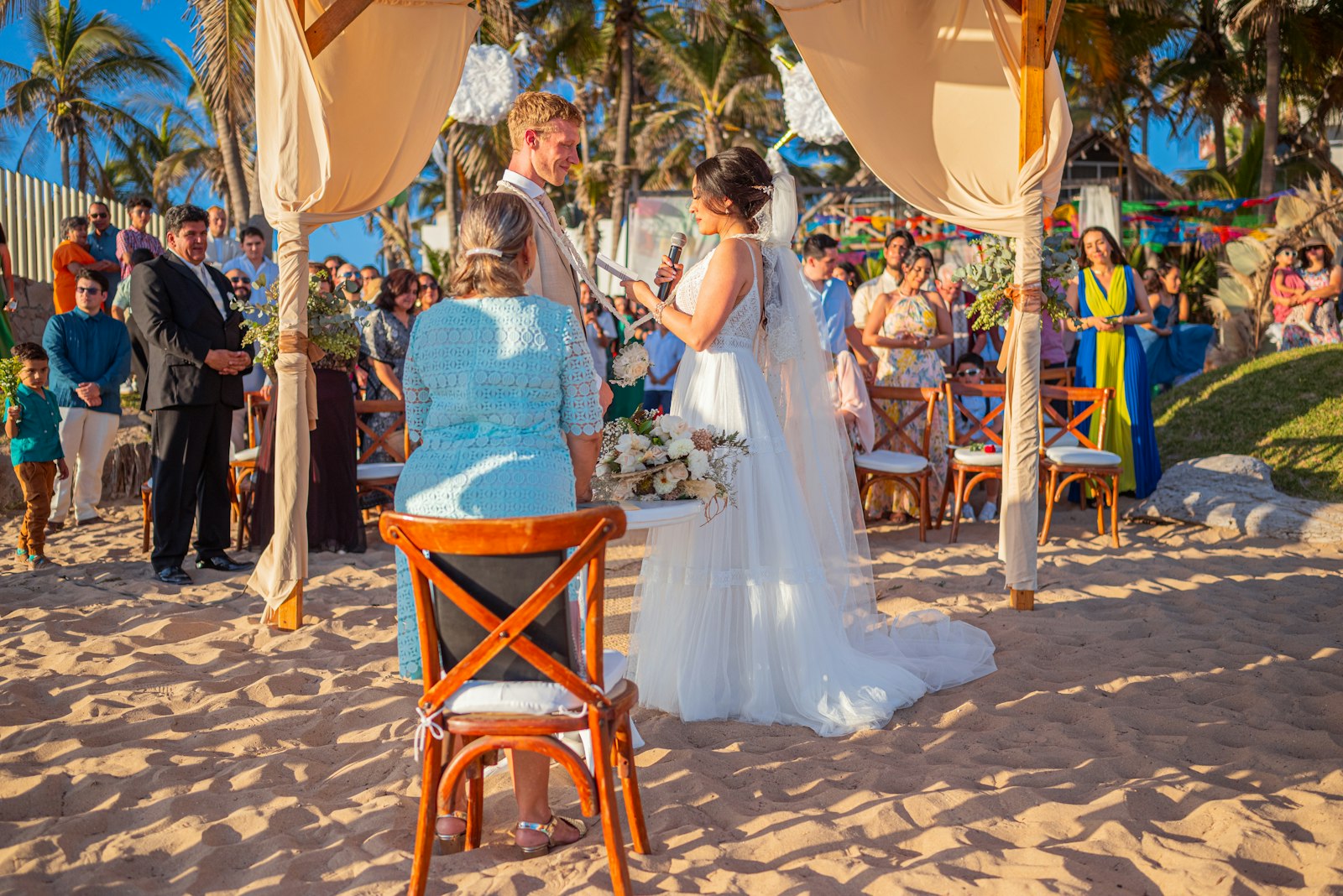
Once your older guests arrive, the ceremony itself presents a second set of challenges. The most iconic settings on Sumba — clifftop bluffs overlooking the Indian Ocean, open beach stretches, savannah ceremony lawns — share certain characteristics that are fine for a fit thirty-year-old and harder for someone with limited mobility or heat sensitivity.
Terrain and footing
Grass lawns after irrigation can be soft and uneven. Clifftop sites involve at minimum a walk across rocky ground or a lawn slope to reach the ceremony space. Paths are rarely paved in the manicured way a hotel ballroom offers. Any guest who uses a walking aid needs a route assessment in advance — specifically, whether the distance from where a car can drop them to where they will sit is flat and firm enough.
Sun and heat
Dry-season daytime highs on Sumba run 30–33°C. That is warm rather than extreme, but sustained sun exposure at a two-hour outdoor ceremony is a real heat-stress risk for elderly guests, particularly those on diuretics, antihypertensives, or other medications that affect temperature regulation. A north- or west-facing ceremony site in late afternoon will be far gentler than a south-coast clifftop at noon.
Wind
June through August brings the Australian SE monsoon, and on Sumba’s south coast that wind is persistent and sometimes strong. It makes for dramatic photos. It also scatters ceremony papers, blows over standing candles, and — less dramatically but more importantly — chills older guests faster than the air temperature suggests, especially if they are sitting still for an extended period. Exposed south-coast ceremony sites in July are not the place to seat a guest whose thermoregulation is poor.
Accessible Travel Sumba Wedding: What Actually Helps
None of the challenges above are deal-breakers for a thoughtful planner. Here is what consistently makes the difference.
Break the journey in Bali — seriously consider an overnight
The single highest-leverage mitigation for older guests is a genuine layover in Bali, not a two-hour airport transit. Build in at least one night in a comfortable hotel near DPS. This lets them recover from long-haul jet lag before the turboprop and the transfer. For guests over eighty or those with cardiac or respiratory conditions, two nights in Bali makes the trip significantly more manageable. A guest who arrives in Bali on Tuesday morning, sleeps Tuesday and Wednesday night, and flies TMC Thursday is a different person from one who connects same-day.
Choose the right aircraft connection timing
Turboprop flights operate on regional schedules that change seasonally — confirm live schedules close to the wedding date rather than relying on static references. When you have schedule flexibility, favour morning departures from DPS for the Sumba hop: convective turbulence in eastern Indonesia is typically lower before early afternoon, and it gives guests the full day to recover at the property before the next day’s events.
Private transfers, padded timing, and the right vehicle
Skip shared shuttles for older guests entirely. A private car — ideally a comfortable SUV or people-carrier with working air-conditioning — allows the driver to stop if someone feels unwell, adjust speed on rough sections, and take a different route if needed. Build 30–50% more time into the transfer estimate than you think you need. A journey that takes a healthy adult 50 minutes can take 80 minutes when you factor in one rest stop, slower boarding, and a cautious pace on the rough sections. Confirm that the vehicle can get close enough to the airport arrivals exit that your guest does not have to walk far with luggage in heat.
Choose your ceremony site with mobility in mind
When you visit potential ceremony sites during your venue recce — and this visit should happen before you sign anything — walk the exact guest path from drop-off to seat. Time it. Identify where firm footing ends and grass or rock begins. Ask the venue coordinator whether a temporary solid walkway can be laid for the ceremony, and whether a vehicle can drop mobility-impaired guests closer than the standard route. West and northwest-facing ceremony sites will generally be more sheltered from the SE monsoon than south-coast clifftops in peak dry season.
Seating, shade, and hydration logistics
Shade structures are not standard at outdoor Sumba ceremonies — you need to plan and budget for them specifically. A garden parasol per elderly guest or a proper shade sail over the seating section is a practical line item, not a luxury. Seats should have armrests and a firm base; camping-style fold-flat chairs that sag are genuinely difficult for guests who cannot easily rise from low positions. Cold drinking water should be at every seat before guests arrive and replenished throughout. This also applies to your ceremony crew: a guest who becomes faint from heat during the vows is a logistical and emotional event neither they nor you want.
Brief guests honestly before they commit
This is the hardest but most important piece. Send older guests — or their adult children helping them plan — a candid one-page travel note before they book flights. Include: the turboprop connection and what it involves, the road transfer and its approximate duration, the outdoor ceremony footing, the heat, and a clear statement that Sumba has limited medical facilities (more on this below). Let them make an informed decision. A guest who knows what to expect and still wants to come is a guest who will enjoy it. A guest who expected a resort lobby ceremony and discovers a clifftop in 32°C sun is a guest who may struggle and feel deceived.
Being honest here is also kindness. Some guests — those who are genuinely very frail, who have had a recent hospitalisation, or whose physician advises against long-haul travel — may be better served by a smaller gathering in Bali before or after the Sumba wedding. A Bali celebration is far more accessible: international airport with jet bridges, flat hotel corridors, medical facilities at every major resort cluster, and air-conditioned everything. That is not a consolation prize; it is a realistic alternative that lets those guests participate meaningfully without a journey that risks their health.
Planning the guest list for your Sumba wedding? Our concierge team can help you think through which guests need extra logistics support and how to structure the trip to make it realistic for everyone. Reach us via our enquiry form or WhatsApp at +62 811 3941 4563.
Health and Medical Context — Information, Not Advice
This section covers factual health context that any traveller to Sumba should know. It is not medical advice, and your older guests — and their physicians — need to make their own decisions based on individual circumstances. What follows is the information layer that lets them have that conversation.
Medical facilities on Sumba
Sumba has basic local medical facilities in its main towns. There is no private hospital with specialist care, no cardiac catheterisation lab, no intensive care unit equivalent to what a major city provides. For any serious medical event — a cardiac episode, a significant fall, a stroke — the pathway is stabilisation locally followed by medical evacuation to Bali or Jakarta. Travel time from a remote resort to a Bali hospital, including ground transfer to Tambolaka, the flight, and ground transfer at DPS, is several hours at minimum.
This is not a reason to exclude older guests categorically. It is a reason to require that every guest, and especially every older guest, carries comprehensive travel insurance that explicitly includes medical evacuation. Budget policies that cap at a low medical limit or exclude evacuation are not adequate for a destination this remote. Ask your insurer specifically about air ambulance from Eastern Indonesia and get the answer in writing before you travel.
Malaria
Sumba and the wider Nusa Tenggara region are in an area with ongoing malaria transmission. This is meaningfully different from Bali, where malaria risk is generally considered low. For older guests — and for all guests — the appropriate step is to consult a travel-medicine clinic or physician several weeks before travel to discuss prophylaxis options. Protocols and risk assessments are updated periodically, so current medical guidance should come from a qualified practitioner, not from a wedding blog. The point for planning purposes: this consultation needs to happen far enough in advance that a course of medication can begin on schedule if advised.
Dengue fever
Dengue is present in Sumba, transmitted by the Aedes mosquito, which bites during the day. Long-sleeved clothing, reef-safe repellent, and avoiding standing water around accommodation are the practical measures. For older guests who may already take blood-thinning medications, dengue’s effects on platelet count make prevention especially relevant. Again, a pre-travel medicine consultation is the right venue for personalised guidance.
Food, water, and stomach illness
Tap water in Sumba is not safe to drink. Bottled or boiled water is the standard for all guests. Ice at reputable resort venues is generally made from filtered water, but at any food stall or local restaurant outside the resort the same caution applies that you would use anywhere in rural eastern Indonesia. Gastrointestinal illness is common for travellers who are not cautious. For older guests with compromised immune systems or on medications that affect gut function, a stomach bug in a remote location is a more serious matter than it would be at home. Discuss any specific dietary or preparation requirements with the resort’s F&B team in advance.
Practical Logistics Checklist for Older Guests
- Travel insurance
- Medical evacuation coverage from eastern Indonesia is non-negotiable. Verify the policy explicitly covers air ambulance and hospitalisation in Bali/Jakarta.
- Pre-travel medical consultation
- Should happen 6–8 weeks before departure — earlier than most guests plan — to allow time for any vaccination series or prophylaxis course to complete.
- Visa
- Most Western nationalities qualify for Indonesia’s e-Visa on Arrival (e-VoA) at around USD 30–35 for 30 days, extendable once for another 30 days. Apply at evisa.imigrasi.go.id. Rules change, so verify eligibility close to travel and check with your own embassy if uncertain.
- Cash / ATMs
- ATMs on Sumba are limited in number and can be offline or empty. Withdraw sufficient Indonesian rupiah in Bali before the connection flight. Carry two cards as backup. Many places outside resort properties are cash-only.
- Power
- Indonesia uses 220V 50Hz with Type C and F plugs (the round two-pin European type). A universal travel adapter and a portable power bank are useful. Rural power cuts do occur.
- Connectivity
- Mobile data is patchy outside Sumba’s main towns. International roaming works intermittently; do not rely on it for emergencies. Resorts typically have Wi-Fi but speeds vary. Guests who depend on telehealth consultations or medication reminder apps should plan for connectivity gaps.
- Medications
- Bring more than needed — a generous surplus — in carry-on luggage, not checked bags. Pharmacy access on Sumba is limited and specific medications may not be available. Carry a list of generic drug names and dosages in case of questions with local medical staff.
- Timezone
- Sumba operates on WITA (UTC+8), the same timezone as Bali and Singapore. Jet lag adjustment for guests from Europe or the Americas is a real factor to build into the schedule.
A Comparison: What to Expect at Each Stage
| Journey Stage | What Older Guests Encounter | Mitigation |
|---|---|---|
| Long-haul to Bali | 12–17+ hrs, jet lag, compression risk | 1–2 nights in Bali before onward connection; aisle seats; compression socks |
| DPS → TMC turboprop (~75–90 min) | ATR aircraft, external stairs, louder cabin, possible light turbulence | Morning departures; notify airline of mobility needs; ground assistance request in advance |
| Tambolaka Airport | Small terminal, limited facilities, heat on apron, bag handling | Meet-and-assist arranged in advance; private transfer vehicle close to exit |
| Road transfer to resort | 40–90+ min on rough roads; bumps; heat | Private air-conditioned vehicle; rest stop if needed; pad timing; cold water in car |
| Outdoor ceremony site | Uneven ground, sun (30–33°C), SE monsoon wind Jun–Aug | Shade structure, firm seating with armrests, firm access path, afternoon timing, sheltered site |
| Medical emergency | Local basic facilities; evacuation to Bali/Jakarta takes several hours | Comprehensive travel insurance with medical evacuation; pre-travel doctor consultation |
The Honest Verdict on Is Sumba Hard for Grandparents
It depends — and that answer is worth sitting with rather than glossing over with reassurance.
A grandparent who is mobile, generally healthy, has no recent major medical events, can manage stairs without assistance, and tolerates heat reasonably well can absolutely attend a Sumba wedding. With a Bali stopover built in, a private transfer, a shaded seat at the ceremony, honest pre-trip briefing, and proper travel insurance, the trip is demanding but doable. Plenty of older guests do it and find the experience unforgettable.
A grandparent who uses a wheelchair full-time, has significant cardiac or respiratory disease, needs daily specialist nursing input, or whose physician has flagged against long-haul travel: Sumba is not the right destination for them, and no amount of planning changes that. The island’s remoteness is part of its character and its appeal — it is also a hard constraint on what is medically reasonable to attempt.
Between those two ends of the spectrum sits the largest category: guests who are older, perhaps slower, perhaps with one or two managed health conditions, who could make the trip with careful planning and honest information. Those are the people this guide is written for. The question to ask is not “is Sumba accessible in the way a city hotel is” — it is not, and it never will be — but “have we done everything reasonable to make this trip safe and enjoyable for this specific person.”
If the answer is yes, go. If the answer is no, or you cannot honestly get there, a Bali gathering before the wedding is a genuinely lovely alternative that is not a lesser experience — just a different and more accessible one.
Working With Your Concierge and Venue
The practicalities above — meet-and-assist at the airport, vehicle specification, shade installation at the ceremony site, rest-stop planning for the transfer — are all things a good destination wedding concierge or venue coordinator can help with. They are not unusual requests in the HNWI wedding space; they are the detail that separates a smooth event from a stressful one.
When you inquire with any property, name your mobility-sensitive guests specifically and ask how the property handles them. Ask about the distance from guest room to ceremony site. Ask whether vehicles can drop guests immediately adjacent to seating. Ask whether firm temporary walkways can be laid. A venue that cannot answer these questions is a venue that has not thought seriously about accessibility; that is useful information to have before you sign a contract.
If you are still mapping the guest list and logistics, or trying to decide whether a Bali gathering for the most fragile relatives makes sense alongside the Sumba wedding, that is exactly the kind of planning conversation our team does well. Use our enquiry form or reach us directly on WhatsApp at +62 811 3941 4563 — no obligation, and we are happy to think it through with you before any decisions are made. If you go on to work with a property or supplier through our recommendation, they may pay us a referral fee at no extra cost to you.
Related Reading
- Getting to Sumba: Flights, Airports, and Transfer Times
- Where Guests Stay: Accommodation Options Beyond the Wedding Resort
- Sumba Wedding FAQ
Frequently Asked Questions
Can a guest in a wheelchair attend a Sumba wedding?
It depends heavily on the specific ceremony site and the degree of mobility limitation. The island’s outdoor settings, ATR aircraft with external stairs, and rough road transfers create real barriers for guests who are fully wheelchair-dependent. Some venues may be able to accommodate a light wheelchair if advance arrangements are made — confirm with the specific property before inviting the guest. For guests who use a wheelchair for longer distances but can stand and transfer for short periods, the trip is more feasible with careful logistics. No one can answer this reliably in the abstract; it requires a site-by-site and guest-by-guest assessment.
Is there a doctor or hospital near Sumba wedding venues?
Sumba has basic local medical clinics and small hospitals in its main towns, but no specialist hospital facility comparable to what you would find in Bali or Jakarta. For serious medical events, the realistic pathway is stabilisation locally and then medical evacuation to Bali. That transfer takes several hours in total. Travel insurance with explicit medical evacuation coverage is essential for all guests, and especially for older travellers — verify the policy covers air ambulance from eastern Indonesia before you travel.
How do I tell an elderly relative that Sumba might not be right for them?
Send them (or their adult child helping them plan) a candid travel note covering the full journey: the long-haul flight, the turboprop connection on an ATR aircraft with external stairs, the rough road transfer, the outdoor ceremony in heat, and the limited medical facilities. Frame it as information they need to make a good decision, not a decision you are making for them. If they want to come after reading that and their doctor agrees, support them. If the trip is genuinely beyond what their health allows, a Bali gathering before or after the Sumba wedding is a meaningful alternative — present it as a real option, not a consolation prize.
Is it safe for older guests to visit Sumba given malaria?
Sumba is in a region with ongoing malaria transmission, unlike Bali where risk is generally considered low. This is information to act on, not a reason to cancel automatically. The standard guidance for all guests — older or younger — is to consult a travel-medicine doctor or clinic at least 6–8 weeks before departure to discuss whether prophylaxis is appropriate and which option suits their health profile and other medications. Dengue is also present on the island, so bite prevention (long sleeves, repellent) applies during daytime hours as well.
What is the best time of year to minimise heat stress for older guests?
The core dry season runs from roughly June through September, with mid-June to late August considered the most reliable window for outdoor ceremonies. Daytime highs in this period sit around 30–33°C — warm but not extreme compared to Sumba’s pre-monsoon peak in October–November when temperatures can reach 35–36°C in parts of the island. The trade-off in the June–August window is the SE monsoon wind on south-facing ceremony sites, which can be strong and persistent. An afternoon ceremony — after 4pm — in a slightly sheltered west or northwest-facing location hits the sweet spot: lower sun angle, cooling breeze rather than scorching wind, and golden light that happens to photograph beautifully.